
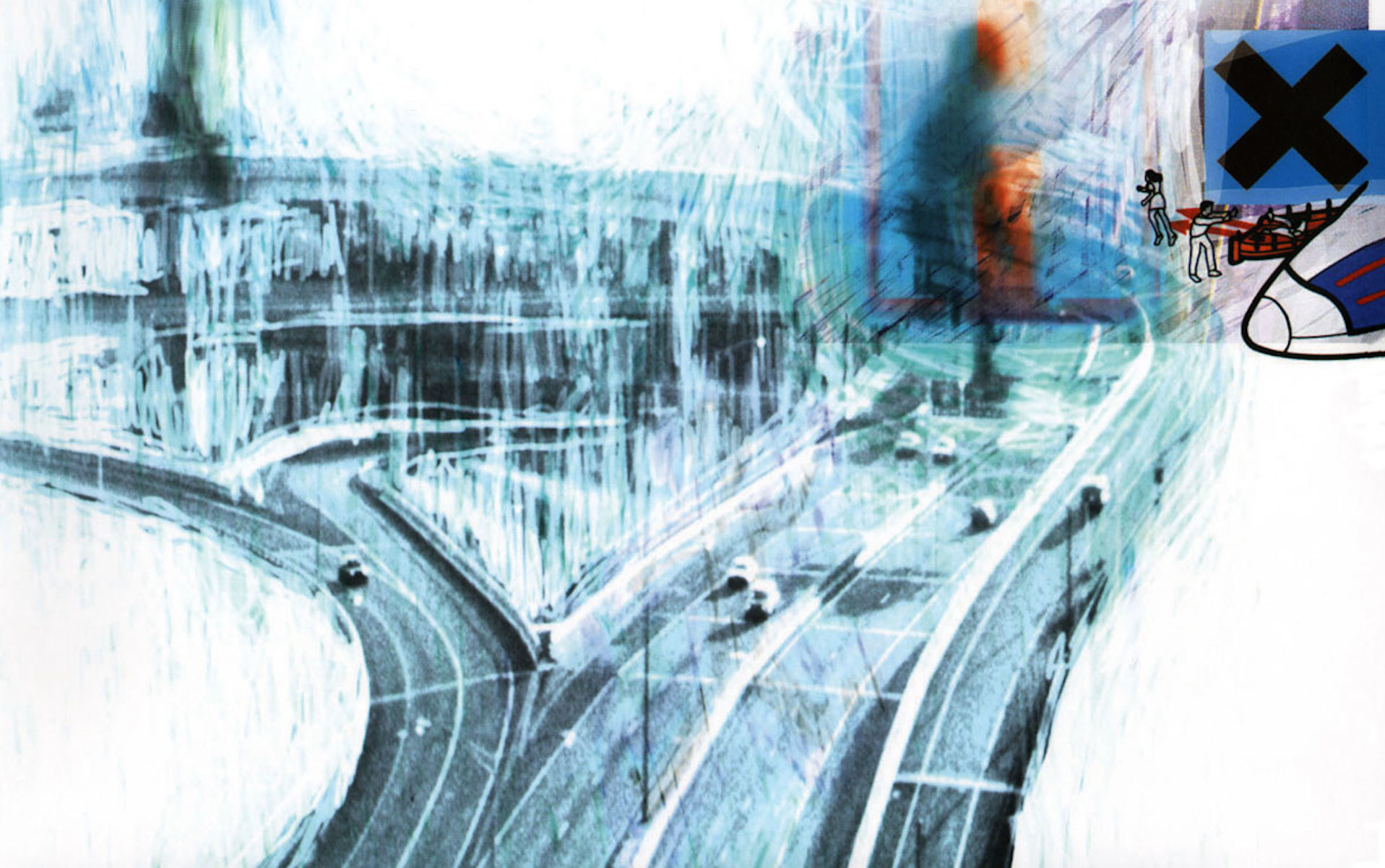
Radiohead’s seminal Computer Age album turns 25
“I’ll take a quiet life, a handshake, some carbon monoxide” – No Surprises
The name OK Computer is a reference to Hitchhiker’s Guide to the Galaxy, a sci-fi novel published in 1979 and perhaps the greatest postmodern satire ever written. It’s a farce about space travel, and science, and silly things and how dangerous all of those silly things can be in the right and wrong hands. One of the main characters, Zaphod Beetlebrox, issues his futuristic space computer a command by saying, “OK Computer, I want full manual control now”.
The band’s name, Radiohead, was taken from a Talking Heads song about a computer factory worker who believed radio signals were implanting messages directly into his brain. They chose that line from that book as the perfect title to express their not-so-subtle message about the perils of this new-fangled Computer Age. It was all very on brand.
Keep in mind that when the album was released in 1997 the internet was a (ghost-in-the) shell of its current glory. For those of us who remember those days fondly, it’s an unrecognizable relic by today’s standards. It was mostly just text chats and email services. As Bo Burnham observed, “it was catalogs, travels blog, a chat room or two”.
We hadn’t fully imagined what digital assistants like Siri, Alexa, and Cortana would even look like. We hadn’t truly yet understood the paranoia, the privacy concerns, the loneliness, and the isolation that comes with living lives that are fully integrated with communication technology.
Asking Alexa to play the album as I write this, her synthetic voice responds like a female version of Fitter Happier. I’m astonished just how much of our current reality has kept pace with the issues OK Computer primarily concerns itself with. Celebrating the 25th anniversary of the album’s release, I find the legacy of one of rock’s greatest achievements to be how well it understood the future long before we finally got there.
OK Computer, at its core, is an album about the dangers of what we could clearly see on the horizon: a digitized, dystopian future, one we may now find ourselves living in. It’s about how it’s so easy to lose your identity among the beeps and boops, or in the parlance of our times, the Facebook notifications and Twitter alerts.
That is to say that the album is prescient, if not shockingly so, then at least impressively so. In fact, it’s eerie at times, listening to it today and looking at the world around me. It’s an album about the perils of unchecked consumerism. It explores the emotional isolation a digital society creates. It also expresses fears over the darkening political malaise of late 20th century governments, the likes of which we see so often from those who leads us in these current times. We certainly were on this path well before the album debuted in 1997. It’s just scary to think we’ve stayed on it all this time.
The song ‘Paranoid Android’ is another reference to Hitchhiker’s Guide. It was inspired by an unsavory experience the band had at a bar in Los Angeles when a woman became violent after a drink was spilled on her. A kicking, squealing Gucci little piggy, if you will. Sounds like an episode of the Real Housewives, before reality TV became a staple of popular programming.
‘Let Down’ is about the fear of being trapped in a loop, traveling from one destination to another without control of the journey. It was an observation and indictment of what the band viewed, at the time at least, as the apathy of Gen X. We scurry around, hamsters on our wheels, and the feeling leaves us empty.
Other songs like ‘Electioneering’ have direct ties to our modern attitudes on politics. The idea of engineering an election was far less palatable for the average citizen in the 90s than it is in the recent post-election trash heap we call democracy. ‘Climbing Up Walls’, one of my favorite Radiohead deep cuts, came from singer Thom Yorke’s time as an orderly in a mental hospital. It shines a light on the very real and very dangerous threat that the intersection of paranoia and mental illness can breed in a culture increasingly focused on isolation and verisimilitude.
‘No Surprises’ is a haunting, modern lullaby about the overwhelming lassitude that comes from burying the important things in life while swimming in a sea of empty consumerism and broken political promises. ‘The Tourist’ was written from Thom’s experiences watching tourist frantically race through Paris to see every last site, an ode to the very human inclination of racing through the journey to get to the end.
“This is what you get when you mess with us” – Karma Police
If any of these things sounds topical, they are. They were then too, and they certainly are now. Of course, this isn’t to undercut the breathtaking sonic achievements of the album, creating pop rock music both familiar and entirely foreign. Music that’s starkly original and also inspired by the musical stylings of many others. And that’s kind of the point. Nothing will ever be new under the sun ever again.
The album’s obvious influences include the Pixies, Pink Floyd, and even Fleetwood Mac, as well as the writings of Thomas Pynchon, George Orwell and Aldous Huxley, among others. Everything owes a debt to something else. Even ‘Karma Police’, a song about losing your identity in the buzzing, static boardroom culture of Reagan era-American Psycho capitalism, owes a debt to the Beatles’ song Sexy Sadie for that powerful intro. That song itself was about the dangers of charismatic leaders.
The title of the song ‘Subterranean Homesick Alien’, a track about aliens observing the sad and perplexing nature of human behavior, is a homage to a Bob Dylan song that served as an ode to the Beatnik era. The Dylan song’s title was inspired by the name of a Kerouac novel. The songs are an amalgam of things, seen and unseen, that were creeping into our culture at the time. Just as our culture itself is an amalgam of the cultures that preceded it. Just as we are an amalgam of the people who came before us and will come after.
“The dust and the screaming. The yuppies networking. The panic, the vomit. God loves his children” – Paranoid Android
Does OK Computer actually predict, 25 years later, our modern cultural oeuvre? Did Radiohead know there would be an AI assistant in every home when Thom Yorke strung together numerous empty platitudes for Fitter Happier and played it through the synthesized vocals of Fred, a SimpleText application on a pre-Steve Jobs-the-sequel Macintosh? Did an album about greed, corruption, vacant consumerism, and the social alienation that would accompany an ever-industrializing society intend to have as much of an insight? Did it predict what was in store for us this deep in the new millennium? Of course not, but we are now where they were afraid we would end up all along.
It’s doubtful that Thom and Co. were doing anything else but commenting on the things they were seeing happen at the time, trends and tendencies, that would carry us into the future. Still, crystal ball or not, this year the Supreme Court repealed Roe vs. Wade. Russia invaded Ukraine, a war that is still raging as this article is being written. The outgoing President of the United States sat by while insurgents stormed the Capital Building.
It’s hard not to think in times like these that lyrics like “Bring down the government, they don’t speak for us” show us nothing has really changed. Lines like “Concerned but powerless” or “Pragmatism not idealism” or “We hope your rules and wisdom choke you” may have been plucked from some highlight reel of the future. Maybe it was provided to the band by the aforementioned aliens who were observing how mundane and banal the human experience can be.
A better writer and music critic might have talked more about the sounds, the harmony, the equal parts angelic and distraught voice of Thom Yorke, the place the album may yet or perhaps has already taken in music history. My view is more myopic. OK Computer was an album I listened to when I felt alone as a young man going through the changing seasons of life, and it’s an album I listen to now when I’m overwhelmed with the ephemera of modern living. It’s still as relevant today as it was 25 years ago and, if our current trajectory has anything to say about it, probably will be 25 years from now. I really do still want to take that quiet life, a handshake and some carbon monoxide.
Oh, and on a side note: an airbag actually did save my life. (Story for another time, friends)


Leave a Reply