
Any attempt to deconstruct the entirety of the Doctor Who series from its inception in 1963 to the modern day would require one to unravel a big ball of wibbly-wobbly, timey-wimey stuff. It would be a task that could prove more daunting than trying to use logic to understand how the Master somehow keeps surviving after their inescapable deaths in every serial. To put it simply then, Doctor Who is a show filled with genius and charm, tales of derring-do and sweeping spectacle.
It’s also a show that over the course of its long history has had its fair share of shlock and cheese, continuity errors and frustrating ends to beloved characters and stories. It’s had many highs, and many many lows, and the quality clearly waxes and wanes between cycles of new Doctors, showrunners, writers and production staff. Still, across all the eras there’s something for everyone, a favorite companion, a favorite storyline and of course, a favorite Doctor.
The show, now preparing to celebrate it’s 60th anniversary, is an unparalleled achievement in serialized television. As of this writing there are 870 episodes, 299 separate story arcs, 39 seasons, 26 specials, a made for TV movie, 5 spin off shows, two animated serials and numerous audio dramas, books, comics and various media all detailing the adventures of the Doctor on their journey through time and space produced over 60 years of time in the real world.
The width and breath of the Doctor’s universe is simply staggering. A show that has run for so long and has so much spin-off media means so many creatives have had their hand in building the world of the Doctor and the Tardis. Faces, places and even the Tardis itself is constantly changing from one incarnation to the next at a pace so dizzying you feel like just as one Doctor has settled into the role they’re immediately regenerating into the next.
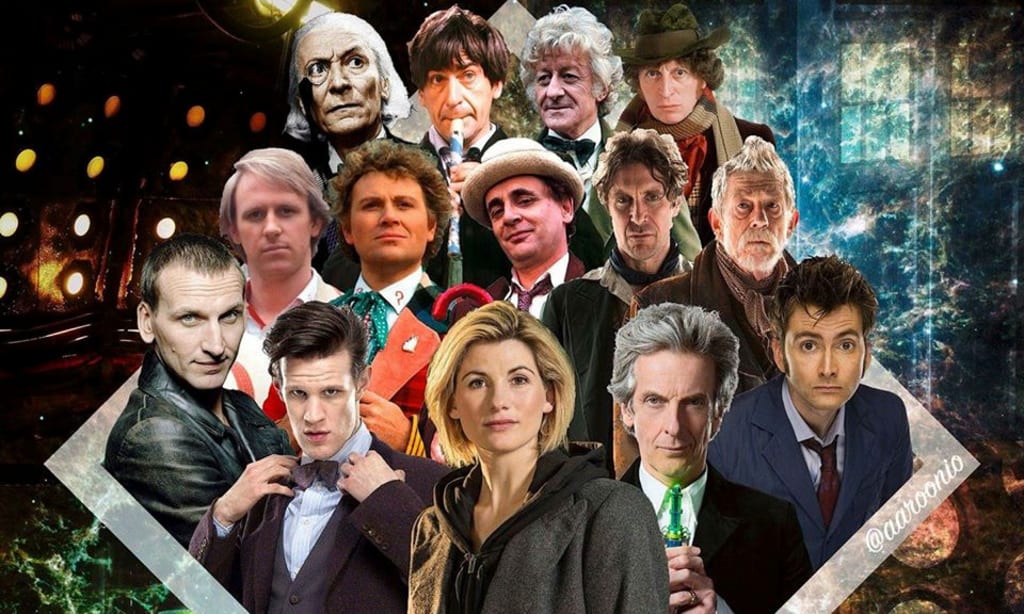
Given the breadth of content that comprises the whole of Doctor Who it’s very unlikely many people have seen the series in its entirety from William Hartnell’s 1st cranky old Doctor to Jodie Whittaker’s bubbly but world weary 13th Doctor. It may actually be impossible since 97 of the 253 episodes that aired during the first six years of its run are lost, most likely forever.
In the late 60s and early 70s the BBC would routinely delete programs that were in their archives. Most of the reasons were practical, things like running out of storage space, losing rebroadcast rights, etc. As a result of this culling there are 26 serials (most taking place during the second and third doctors runs) that are lost to time, as it were. That’s about 11% of all aired episodes.
So how do you, as a new or returning viewer, connect to a contiguous story (more or less) told over decades with a back catalog as large as Doctor Who? Through the Doctor themselves, of course. The one constant of the show from its inception is the Doctor in the Tardis, roaming around time and space, usually with companions that accompany them on their journey. For all the different faces (both Doctors and companions) and different places the show has gone the formula of the Doctor landing on earth in the past, or the future, or on an alien world, also in the past or the future, and solving some sort of crisis has run through the show’s DNA from the first episode to the most recent.
Despite the 60 year spread very little in that regard has changed. It’s true that the original series had shorter runtimes with more episodes per season and relied heavily on serialized story arcs, which is structurally different than the modern hour run time that, for the most part, is more episodic in nature. Still, the format has remained more or less the same.
The format isn’t the only thread connecting the future of the show to its past. For a character played by so many different, and in recent years at least, diverse actors its amazing that the Doctor is still so recognizably THE DOCTOR throughout the show’s whole history. The first Doctor, played by William Hartnell in the classic series (then Richard Hurndall for the Five Doctors anniversary special and later David Bradley in the modern series), started out as a curmudgeonly explorer of space and time living in exile on the planet earth.
Over time he warmed to the idea of traveling the universe and specifically traveling with companions, springboarding the rotating cast of characters who travel with the Doctor throughout all of time and space. His origins were modest by the modern show’s standards. By the time he was rocking his 11th incarnation he had become a man that could turn entire armies around at the mention of his name. River Song even asks Matt Smith’s Eleven if he could have imagined when he first stole a Tardis and fled Gallifrey all those years ago that he would one day become the most feared person in the galaxy.
That wasn’t an overnight change by any means. In the original serials the Doctor and his companions fled for their lives back to the Tardis as much as they won the day. Building the myth of the Doctor over so long a timeline allowed for a natural evolution from cranky explorer to dashing hero (and back perhaps). The fact that the Doctor has an “arc” of sorts over a multitude of seasons and changing actors is quite the feat but perhaps even more impressive is how “Doctor-y” all of the incarnations feel.
Tom Baker, who played the Fourth Doctor (and held the role for the longest) once said that the Doctor wasn’t “an acting part”, it was part the actor being themselves, part the writers. Maybe that’s truer than anyone else would likely admit. If you watch some of the best actors to take on the role, such as David Tennant, Matt Smith, Sylvester McCoy, Tom Baker, Peter Capaldi, et al, you’ll see similarities between their portrayal of the Doctor and some of their other roles.
The possibility that it all comes down to the right actor and the right scripts makes sense, of course. The Doctor ‘changing’ from regeneration to regeneration in behavior and mannerisms as much as appearance allows for a full reinvention of the character from Doctor to Doctor. When the decision to recast Hartnell, due to his progressive illness, was made, it was clear by choosing Patrick Troughton that the powers that be were looking to shake up who the character was and how they related to audiences.
The Second Doctor changed from a cantankerous old man to a cosmic hobo, an erratic and somewhat whimsical clown of a man, both younger and more energetic than his predecessor. The Second Doctor, more so than the First, set in place some of the characteristics that have followed the Doctor from regeneration to regeneration. What are those characteristics? Well, let’s take a look.
A Mad Man (or Woman) With A Box
Almost every single version of the Doctor has been defined by a goofy charisma, an almost kinetic energy that sees the Doctor frequently thrash about, delivering long winded and sometimes unintelligible monologues filled with technobabble and flights of fancy, flittering about the screen like…well…like a madman with a box. It’s one of the most endearing aspects of the character. The Second Doctor was the first that fully embraced this whimsical nature, bringing a puckish and at times indignant quality to the character.
After a scaling back on the eccentricities in John Pertwee’s more scientific and austere Third Doctor, it was Tom Baker’s Fourth Doctor where the quixotic eccentricisms started to really shine through. It’s a trait that defines all modern Doctors from Chris Eccleston’s Ninth all the way to Thirteen and, with the announcement of Ncuti Gatwa as the next Doctor (authors note: we now know he is the Fifteenth Doctor, with David Tennant briefly returning to the role as Fourteen), it’s something that is sure to continue right on into the future.
(author’s note: This piece was written at the end of Thirteenth Doctor’s run, but I would like to note that bringing back David Tennant fulfills a prophecy made by Tom Baker, in a delightful cameo with Matt Smith at the end of Day of the Doctor, that future incarnations occasionally take the guise of favorite previous ones.)
Peter Davidson’s Fifth Doctor was the first to come across as a dashing, albeit put-upon hero, something that defined the fantastic (and arguably the best) incarnation, David Tennant’s Tenth Doctor. Colin Baker’s Sixth Doctor is generally the least liked, due partly to the attempt at reversing course and losing some of the charisma that defined previous Doctors in an attempt to reboot the cranky, more spiteful First Doctor. The Sylvester McCoy’s Seventh Doctor returned to form with a jocular charm but also a new ingredient: manipulation. Seven wasn’t above a bit of ruthlessness in order to save the day, even at the expense of people he cared for.
It reminded viewers that the Doctor, how ever likeable they may be, is still an alien who has lived for a long, long time with a perspective too vast for others to comprehend. This steely warrior trait, present in both the War Doctor and the Fugitive Doctor (two previously unknown incarnations played brilliantly by William Hurt and Jo Martin respectively) was also rekindled in the main continuity by Peter Capaldi’s Twelfth Doctor.
His companion Clara remarks at one point, with relief, that he was just pretending to be heartless during an attack on a space train. Instead of agreeing or arguing Twelve simply asks her if she would like to think that about him, if it helps her to cope with his actions. After a long life that’s been marred by conflict the Doctor realizes that sometimes the only choices you have are bad ones.
But its not all Daleks and Cybermen, of course. The Eight Doctor first introduced the notion that the Doctor could potentially have or be a love interest, something that would have been a bit unimaginable in the Doctor’s early days. Paul McCann’s brief stint as Eight brought a rouguish, romantic quality to the character that would define several future iterations, most notably Ten. In fact, the relationship between companion Rose Tyler and the Ninth and Tenth Doctors is almost a love story, something that the War Doctor commented on to Eleven in the 50th anniversary special Day of the Doctor.
Nine brought back the goofiness full tilt and a dash of manic energy which may be one of the most definitive character traits of the Doctor, especially in the Modern era. For many Ten and Eleven epitomize the Doctor for the current generation of TV viewer. Playful, eccentric, heroic, dashing, young and energetic, both Doctors sauntered across their respective journeys through time and space with a zeal that was both enviable and magnetic.
Twelve rebooted the character a bit, keeping all the zany tomfoolery of the past two regenerations but also a sort of prickly weariness that hewed much closer (and more successfully) to the First Doctor than any other previous iteration. This was neatly evidenced by the team up between Twelve and One (played here by David Bradley) in the special Twice Upon A Time. Twelve’s era was a delicate balance in the acceptance that the universe and the Doctor both need each other despite all things fading in their time.
Thirteen was a return to the previous form that defined Ten and Eleven, a youthful vigor mixed with a natural curiosity but also a desperation not to be alone, a thematic throughline that served as an undercurrent of the Doctor since the early days of Nine’s run. Now we wait (at the time of this writing) to see the places both physical and emotional that Fourteen and the future will take the character.
The Hoper of Far-Flung Hopes
Ultimately though the Doctor is, at their center, best described as a hopeful character. Optimism isn’t quite the right word (though they are optimistic) to describe the Doctor’s relationship to the universe (or to themselves), which I why I use the word Hope. Despite the occasional despair or frustration that sets in from their long journey through all of time and space, every Doctor ultimately comes to the viewpoint that things can be better, that people (or aliens) and even enemies like the Master, can be better. During the modern Who era (after the events of the Time War) the Doctor is a world-weary traveler, a being displaced in time and more than a bit angry and sad and full of regret.
This wasn’t absent from the Classic Who serials either. In the beginning the First Doctor fears the things he must do. Thousands of years later the Twelfth Doctor laments that though there isn’t anything he can’t do, there is plenty he shouldn’t. He mustn’t. The consequences would be too great. In his own words he puts it as a “duty of care”. So, more often than not the Doctor just does what they can to make all the corners of the universe, large and small, a better place. There is sometimes an accompanying angst of sorts that casts a pall over the often light-hearted adventures the Doctor routinely takes. Yet, always there is a hope, hope and fairness. Hope is the heart(s) of the Doctor, revealed.
Then who is the Doctor? Madame De Pompadour says to Ten in the episode Girl In The Fireplace, arguably the best Who episode of all time, his real name is more than just a secret (one we’ve fully yet to learn). Eleven explains that taking the name of the Doctor is what matters. It’s like a promise you make, the name you choose is who you want to be. So perhaps the answer is simple: The Doctor is an alien from Gallifrey (and beyond) that travels the universe of time (and relative dimension in space) looking for answers to the age old questions of good and evil, helping those along the way who need it. As the Thirteen Doctor says in her introduction, ‘I’m the Doctor, sorting out fair play throughout the universe’.
Thank you, Doctor.
Leave a Reply